Highlights
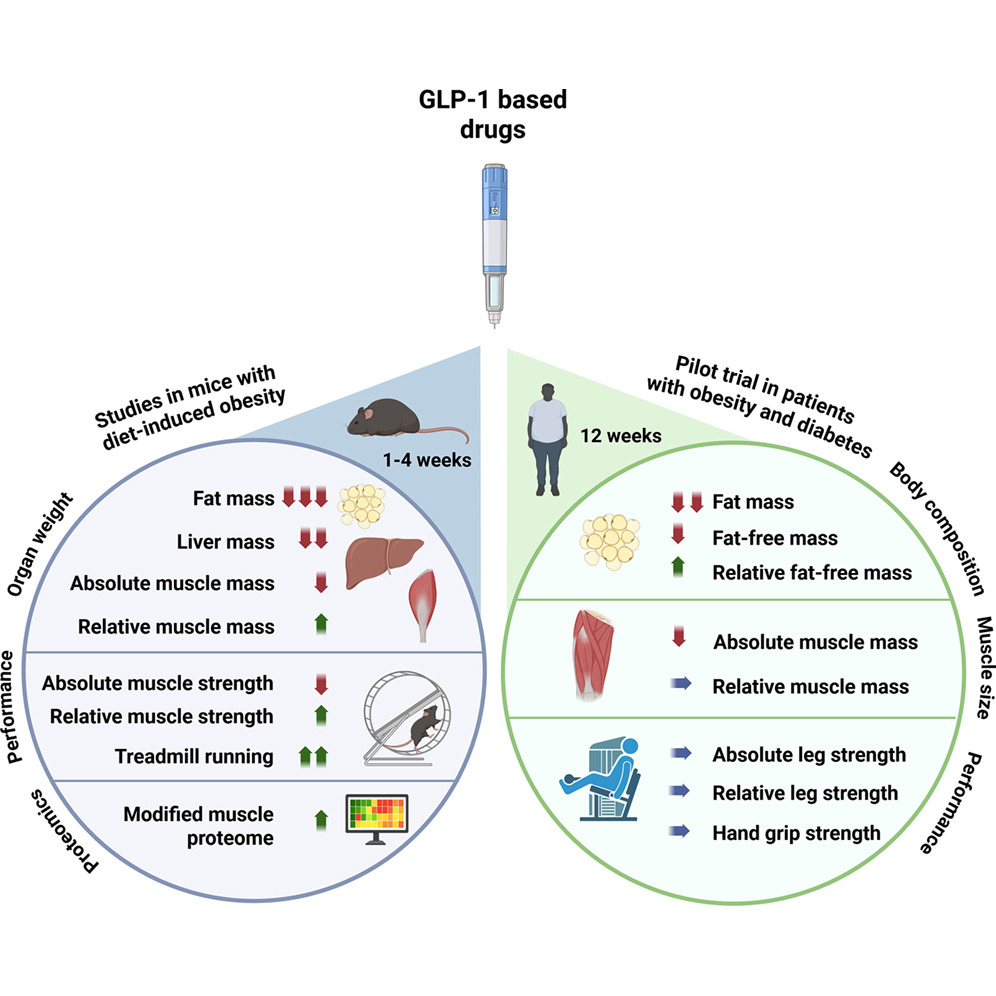
- GLP-1 medicines reduce fat and liver mass more rapidly than skeletal muscle (SKM)
- Running performance is maintained or improved in mice on GLP-1 medicine
- GLP-1 medicine modifies the SKM proteome despite similar weight loss as calorie restriction
- Patients on GLP-1 medicine slightly reduce SKM mass but largely maintain strength
Summary
The large decrease in body weight with glucagon-like peptide-1 (GLP-1) medicines raises concern about a loss of lean body mass (LBM) and skeletal muscle. In this work, we present four pre-clinical studies and a proof-of-concept clinical trial that address this issue. We report that in obese mice, GLP-1 medicines predominantly reduce body fat alongside a small but significant decrease in LBM. Among lean tissues, loss of liver mass exceeds change in muscle mass. While absolute muscle mass and strength decrease, relative muscle mass and strength improve, resulting in better running performance. Interestingly, while atrophy is similar during immobilization, GLP-1 medicines have a distinct effect on the muscle proteome compared to calorie restriction. Patients with obesity on GLP-1 medicines improve their body composition without negatively affecting strength. Overall, in middle-aged mice and men, GLP-1 medicines slightly decrease absolute muscle values but positively impact body composition and mobility.